
 This year, 15 projects have been selected for funding under the Digital Government Innovation Budget. The Ministry of the Interior and Kingdom Relations (BZK) is supporting these projects with funding, guidance and advice. A total of 74 government organisations are collaborating on innovations to make the digital government more accessible, agile and future-proof.
Project criteria & selection process
The Innovatiebudget funds collaborative projects involving at least two Dutch government organisations to improve digital public services. Proposals must be co-financed (25% for small projects, 40% for larger ones) and completed within 12 months. Projects are evaluated based on their reusability, transparency, innovation, and future planning, with a preference for open-source solutions. They should also demonstrate scalability, transparency, and long-term viability while addressing societal needs and digital inclusion. For a complete overview, see the Dutch-language page on project criteria.
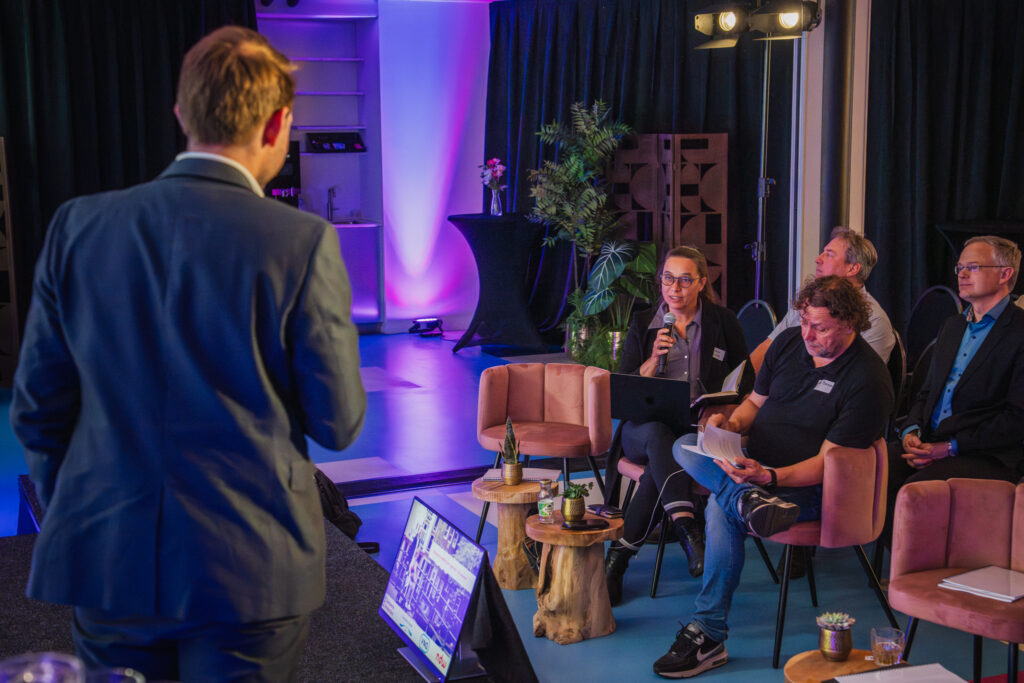
Out of 68 submissions, the top 15 projects were selected through a multi-phase process. Initially, the pre-selection committee and jury narrowed the pool to 19 promising proposals. 9 of these presented their pitches on 3 June 2026. After considering all stages, the jury ultimately selected the final 15 projects.
Wide range of reusable innovations
All projects are developing innovative, reusable and scalable solutions for government, including standards, agreements, generic building blocks and infrastructure. They address a range of themes, from AI applications and accessibility to data quality and service delivery in the Caribbean Netherlands:
- 1 Government Message for Bereaved Families, by ICTU and CAK: 1 government message for next of kin, instead of dozens of separate letters from various government bodies, easing the burden on grieving families.
- D-OmniTwin, by Municipalities of Súdwest-Fryslân, Leeuwarden and Tytsjerksteradiel: Federated data layer that provides insights into areas, using AI to analyse issues such as heat stress or energy poverty.
- AI-Ready Standards & CompliancePush, by Geonovum, Kadaster and BZK: AI-compatible government standards and automatic updates of software when standards change, ensuring compliance and ease of use.
- National Recognisable Entry Design, by 21 municipalities, VNG and 1stroom: Standardised, user-friendly design for municipal services (websites, public counters, etc.) to help residents navigate government services more easily.
- TITAAN, by the Het Waterschapshuis, RVO, RWS, STOWA, NEVSAT: An open, public GeoAI model that detects changes in outdoor spaces from aerial photographs and satellite imagery, enabling proactive intervention.
- Freewheelen, by the Municipalities of Amsterdam, Almere, NDW, VNG, Cliëntenbelang and VIP-groep: A navigation tool that personalises routes for wheelchair users, transforming raw map data into information on accessibility.
- Personal Assistant, by Belastingdienst and UWV: App that combines AI, certified calculation rules, and a digital wallet to clarify citizens’ rights and obligations, including sources of pension-related income.
- The Mapping Assistant, by Dimpact, Municipalities of Emmen, Enschede, Groningen, Rotterdam and Zwolle: Automates the accuracy of data migration mappings across systems, reducing errors and reliance on vendors using AI.
- Secure Business Data Exchange Building Block, by KVK, RVO, NVWA and DICTU: This ‘Business Wallet’ automatically retrieves and shares verified documents (e.g., permits, subsidies) from a secure business vault.
- Learn from Objections, by Municipalities of Amsterdam, Utrecht, Zwolle and Vereniging Juridische Kwaliteitszorg: Open-source tool that analyses objections (e.g., permits) to identify trends and improve decision-making.
- Government-wide Code Platform, by BZK, VWS, Logius, VNG, Kadaster, RWS and developer.overheid.nl: Tests Forgejo, a sovereign platform for government code, reducing reliance on external providers.
- Single Mutation Detection, by the Kadaster and Ministry of BZK: Uses AI and geospatial data (e.g., aerial photos and satellite imagery) to detect changes in physical environments, improving efficiency for land registries.
- Shared Patterns Library, by Municipality of Rotterdam and Dimpact: Library of reusable patterns for government communications (e.g., notifications and permits) that enables faster and more consistent messaging for citizens.
- AI Chatbot for Intergovernmental Concept Frameworks, by IPO, Geonovum and BIJ12: Develops standardised terminology frameworks, improving data exchange and reducing inconsistencies across government bodies.
- Accessible Customer Contact, by RCN, Municipality of The Hague, Public Body Bonaire: Multilingual transcription (Dutch, English, Spanish and Papiamentu) and improved telephone services in the Caribbean Netherlands.
Netherlands’ Digitalisation Strategy
All innovations are being developed as open source, enabling other governments to join directly. As such, these projects contribute to the shared priorities of the Netherlands’ Digitalisation Strategy (NDS).
Do you have any specific questions about how to get involved? Please email innovatiebudget@ictu.nl.


