
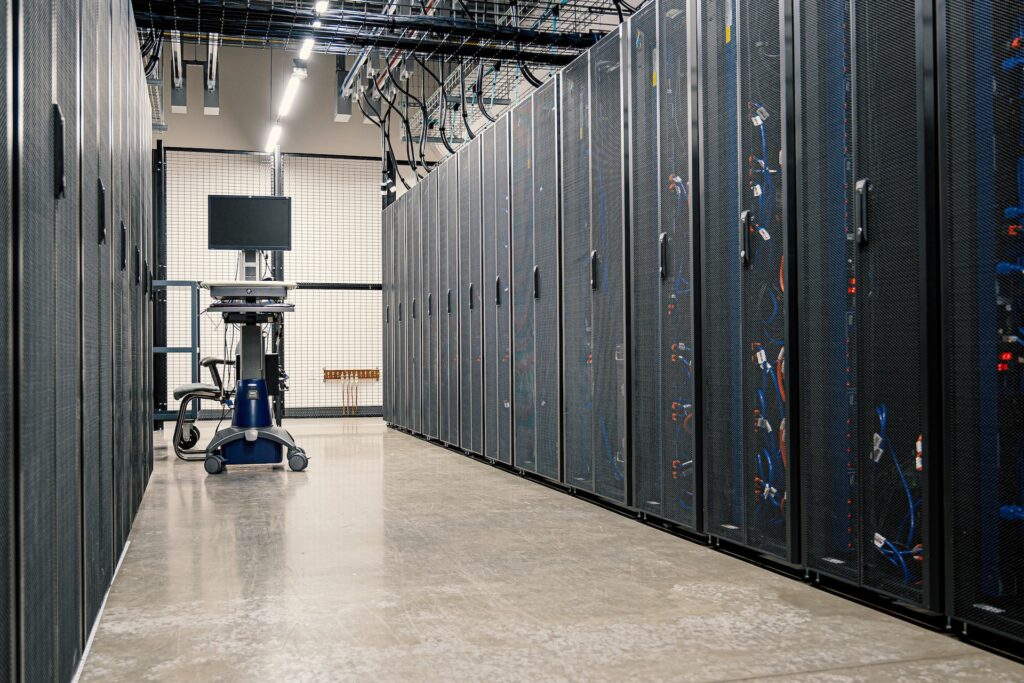
 Under the leadership of the Directorate CIO Rijk (Central Government Chief Information Office) & Digitalisation Policy (formerly CIO Rijk), 4 government data centres (ODCs) successfully completed the first phase of the Sustainable Government Data Centres project in April 2026. CIO Rijk, ODC Rijkswaterstaat & Justitiële Informatievoorziening Organisatie (Directorate-General for Public Works and Water Management & Judicial Information Service), ODC Haaglanden, ODC Belastingdienst (Tax Administration) and ODC-Noord worked together to explore how to make data centres more sustainable in a smarter, faster and more effective way. The conclusion: by sharing knowledge and working together in a targeted way, they identified clear opportunities to save energy and costs while reducing CO₂ emissions.
Data centres are indispensable to digital government. They enable services such as DigiD and tax return filing, as well as the management of infrastructure such as bridges and locks. However, their energy consumption is rising due to increased digitalisation and applications such as AI. According to Statistics Netherlands (CBS), all data centres in the Netherlands accounted for 4.6% of the country’s total electricity consumption in 2024.
Regulatory context
The Netherlands is working towards climate neutrality by 2050 under the Climate Agreement, with the government taking a leading role. At the same time, data centres are facing increasingly stringent legislation and regulation. These requirements demand better insight into energy and water use, renewable energy, and waste heat. This enables more targeted efforts to reduce CO₂ emissions, save energy, and use resources more efficiently.
Sharpening the focus, pooling expertise and resources
Through the Sustainable Government Data Centres project, the government aims to align efforts, improve coordination among ODCs, and deliver tangible results. Eric van der Werf of ODC-Noord explains: “This is also an organisational challenge: how to achieve more output with fewer resources?” During the first phase, the project group examined where pooling resources and expertise could add value. The ODCs focused on knowledge sharing, identifying common challenges and opportunities, and conducting an analysis that produced 5 recommendations for the next phase.
Opportunities for improvement
In addition, the external organisation Interact assessed almost 3,800 servers and identified opportunities to improve server efficiency. The analysis showed that servers are performing well to excellently. It also found that a server’s age is not a reliable predictor of its efficiency. Some 9-year-old servers scored at least as well as 2-year-old servers. This creates opportunities for smarter lifecycle management. In some cases, servers can be kept in use for longer without compromising performance.
The analysis also shows that there is scope for further improvements in sustainability. By making more efficient use of server capacity and planning replacements more intelligently, an estimated 2,674 tonnes of CO₂ equivalent, 11.7 million kWh of energy, and more than €2 million in energy costs could be saved over a 5-year period.
Next steps for the Sustainable Government Data Centres project
The project group has drawn up 5 recommendations for the next phase. For example, the ODCs want to improve how sustainability is measured to provide a more complete picture. The project group also wants to clarify what the government is doing to help data centres operate more efficiently and sustainably.
“Data centres are major energy consumers. We want to explain as clearly as possible what we’re doing to run them as efficiently as possible,” says Jeroen Besse of Rijkswaterstaat. “This also signals to the market that the same level of transparency should be prioritised.” The ODCs are also examining how to use existing capacity more effectively, the opportunities offered by liquid cooling, and ways to increase hardware circularity.
Collaboration as a catalyst
The collaboration among the four ODCs is a key outcome of the first phase. “Everyone is open and transparent, which means we learn a great deal from each other,” says Michael den Ouden of SSC-ICT. “By sharing knowledge, organisations gain a better understanding of each other’s ongoing initiatives, legal obligations and practical solutions. This prevents duplication of effort and makes it easier to reuse approaches that have already proven successful.”
The next phase
In April 2026, the CIO Council endorsed the results of the first phase and unanimously agreed to implement the 5 recommendations to strengthen data-driven sustainability governance. Floor Kloosterman, Head of the I-System and Craftsmanship Department at CIO Rijk and Chair of the steering group, says the results provide a solid foundation for the next phase: “I’m proud of what we’ve achieved together in this first phase. Sustainability is not only a societal responsibility for the government but also a key condition for future-proof digital services.”
Sustainability is an ongoing effort
Efforts to improve sustainability do not end with the project. Jochem van den Berg of the Tax and Customs Administration notes that energy consumption is not determined solely by the data centre. It is also influenced by the rise of AI and by choices in architecture, software development and procurement. “Collaboration and knowledge sharing will therefore remain key to creating a more sustainable digital government.”


