
Work in progress: Roadmap for Digital Autonomy
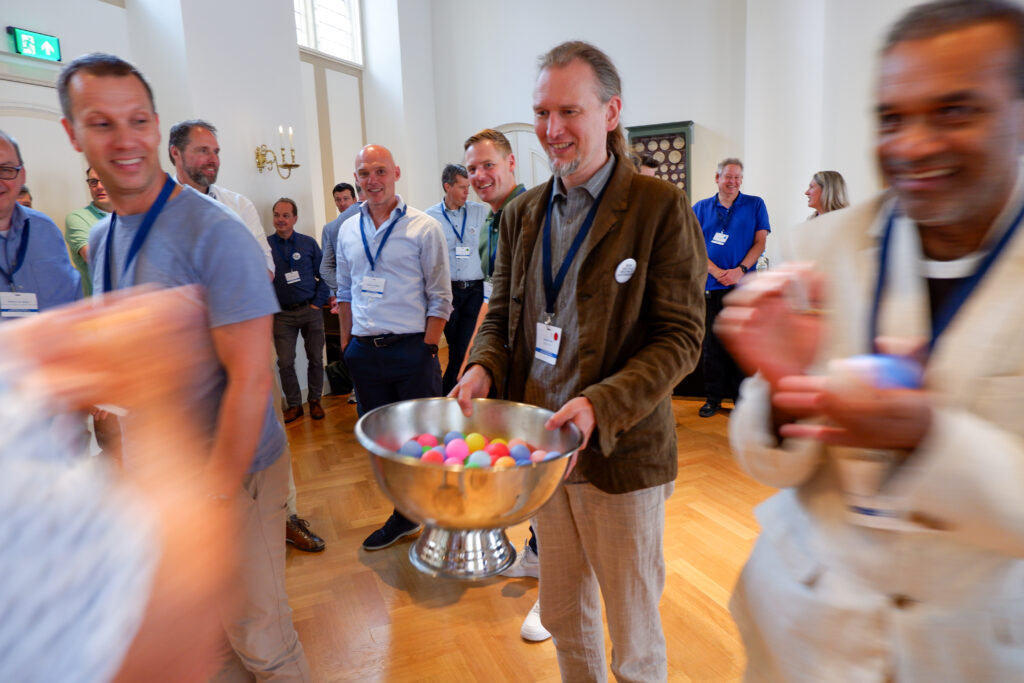
The NDS priority Digital Resilience and Digital Autonomy is developing a Roadmap for Digital Autonomy. To translate this into daily practice, the programme team brought in two designers. They help civil servants see organisations, people, and processes differently and, above all, to act differently.
Michel Osseweijer, programme manager for Digital Autonomy, believes in the added value designers can bring to this process. “How do we, as programme managers, usually go about our work? We book a meeting room with tables arranged in a U-shape and talk. We create a document, have it approved, and then it sets out what people need to do. This time, we wanted to do things differently.”
Putting the puzzle together
The Roadmap for Digital Autonomy is a joint effort that combines the knowledge, experience, and insights of all government bodies, says Osseweijer. “The roadmap input is provided by representatives from all levels of government, including the national government, provinces, municipalities, and water authorities.” These representatives gathered for a workshop in Utrecht. There, they translated the abstract challenge of digital autonomy into their everyday practice. The day focused on putting the puzzle together: sharing experiences, exploring dilemmas, and jointly determining the steps needed to make digital autonomy concrete and actionable. “Our ambition is for the roadmap to grow into a compass that aligns with the reality of all the governments involved,” says Osseweijer.
Getting started
To achieve this, he enlisted the help of Caroline Beck and Juliëtte van Driel from Livework Studio. The designers’ task was not to solve a specific problem but to help people experience how they could get things started. “The path to digital autonomy is a transition,” explains Beck. “Transitions can feel vague, intimidating, and complex. Using simple examples, we clarify these concepts and eliminate confusion.”
Van Driel adds that, “especially in digital transitions,” people’s role and place are crucial. “When it comes to innovation, people quickly think of technology, but that doesn’t always have to be the case. Social interventions are often much more useful. The solution often lies in changing people’s behaviour. We let them experience this through seemingly simple exercises.”
Making the concept of autonomy clear
Another goal for the day was to gain a clear understanding of the transition. Beck says: “Politicians say that 30% of government technology must be autonomous. So we ask: Which services in your organisation are so critical that they require support from autonomous IT?
By asking follow-up questions, participants identified specific examples such as keeping critical tunnels accessible during attacks or ensuring bridges work during power outages. They also discussed autonomous workplaces and data storage with retained control. “Collecting real-life examples makes it easier for people to discuss the overarching themes of the transition,” Beck explains.
Tools for civil servants
Designers have tools such as imagination and experimentation at their disposal. Beck acknowledges that many civil servants find these tools difficult to use. “Behind the hesitation to experiment lie fundamental, bureaucratic values. These are very important, and we respect them. As a government, you don’t want to ‘experiment’ with citizens; they’re too important for that. The government wants to build in certainties because it doesn’t want solutions that make things worse for citizens. That’s ingrained in the way they work. But there are ways to create opportunities anyway.”
Imagination as a muscle
Van Driel describes imagination as a ‘muscle’ that can be developed through practice. He notes that civil servants often don’t see imagination as a valuable tool because government work heavily relies on rules, processes, and structures. On days like this, we provide tools to foster imagination, such as asking people to visualise concepts. However, some hesitate to start drawing, fearing they won’t get it right away. Modifying the exercise creates a very different experience. This design-focused approach encourages professionals to express and visualise their extensive knowledge.
Inquisitive toddlers
Curiosity is another important tool. Van Driel laughs as she admits she often answers clients’ questions with more questions. “Because we want to know what needs really exist within the organisation. In that sense, we sometimes resemble toddlers. We question everything. What is that? Why do you do it that way?”
Beck agrees: “Our clients are the experts, so we let them tell us how things are. We create space for people to experiment, learn, and fail. The latter is important. A government pilot is so well-prepared that it almost can’t fail. But pilots are meant to explore. If a pilot fails, a designer thinks: we’ll do it again, but differently, so we learn what does work.”
The cherry on top
Osseweijer looks back on the workshop with great satisfaction. “This entire day was perfectly designed: the setting, the programme, the tools. Everything was thought through. Because the participants came from all levels of government, there was extra interaction. I saw how people reacted and how they gained new insights. Seemingly simple assignments are designed to cut to the chase. For example, during an exercise with ping-pong balls, a participant suddenly connected it to the transition they are part of. That was the cherry on the cake, as you know, because we’ve made an impact as an organisation.”
In October, a (Dutch-language) webinar will follow, during which the Digital Autonomy programme team will share the results of this workshop. Keep an eye on this event page (Dutch) if you’d like to register.
Accelerator: Policy for greater digital autonomy
The policy for greater digital autonomy accelerates the Digital Resilience and Digital Autonomy priority of the Netherlands’ Digitalisation Strategy (NDS). This accelerator contributes to the government’s vision of digital autonomy and sovereignty by developing strategy, (additional) policy, measures, and implementation support. The goal is for the entire Dutch government to become less dependent on a small number of (non-European) suppliers.
Do you have questions about the NDS, or would you like to collaborate? Email: nds@minbzk.nl. Or visit https://nds.pleio.nl/ to sign up.


