
The Public Services Department of the Ministry of BZK visited Bruges in autumn 2026. This Flemish city is pioneering government-wide public services delivered close to residents’ homes. It is also among the first to develop the Portable Service Desk, a device that enables staff to provide government services on the spot. How did they pull this off? And what makes public services better suited to the people they serve? Here are 4 key lessons.
1. Going beyond the beaten path
Uniform service delivery is a key priority for Bruges: residents should receive the same support wherever they turn. The city has made this a central commitment through a major agreement. By working with many service providers toward this goal, Bruges can make significant progress. Uniform service delivery also means deciding how services are organised in practice. For example, the Huis van de Bruggeling, the city’s central counter and administrative hub, is set to move to a new location, where 2 organisations will share the space.
To ensure all residents receive information, the city relies on ‘guides’ (key contacts). These permanent staff members bridge the gap between non-Dutch speakers and the city. They help residents find available support and services and make them easier to access. “We noticed that we simply weren’t reaching certain groups, for example, when we were temporarily closed. We communicated about it, but some groups still showed up at the door,” says Christine Desmidt, head of the Citizen Services department at Stad Brugge (City of Bruges). The guides know which channels work best in their communities and use them to share important information.
2. Get the technology right
To bring public services closer to residents, Bruges developed the Portable Service Desk. This device enables staff to handle administrative matters and provide government services while working in the community. With the Portable Service Desk, staff visit residents with limited mobility, as well as people in prisons and care facilities. “It’s important to make sure the technology works properly before sending staff out to use it. You don’t want them running into all sorts of problems when they’re on the job,” says Desmidt. “That’s why we went through several rounds of testing. It’s an investment you simply have to make. For example, we found it difficult to maintain a stable internet connection because of the thick concrete walls. We then used what we’d learned to improve the technology.”
3. Bring residents along on the journey
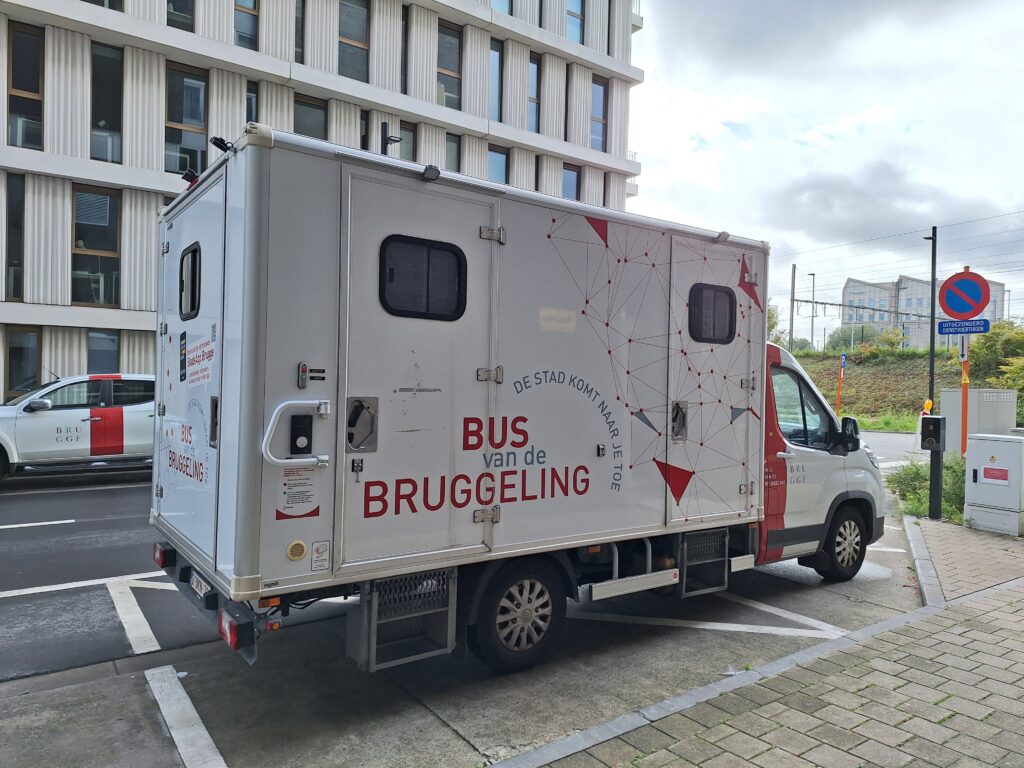
Being close also means being present in places familiar to residents, where they feel at home and can meet others. That’s why Stad Brugge places its staff in various neighbourhood locations, such as community centres. They also set up the Bus van de Bruggeling, a service desk on wheels, at different locations around the city. In addition, the Stadsmagazine informs residents about the new neighbourhood locations. “We use it to introduce staff, because we want to be a familiar face in the neighbourhood,” says Peter Vermeire, acting director of the Customer Directorat.
Because the service desks are located in regular neighbourhood settings, people from different groups now come together. However, as Desmidt says, “We notice that people don’t always want to be openly present for all types of requests, so some appointments are better suited to the Huis van de Bruggeling”. That option will remain available, giving residents a choice. In its letters, the municipality offers two options: the nearest local service desk or the Huis van de Bruggeling. As a result, more and more people are choosing the local option.
4. Address the challenges that come with change
Providing uniform services close to residents’ homes also requires a cultural shift among service desk staff and partner organisations. “Working out in the community means being a guest in someone else’s space,” says Vermeire. “Sometimes we’re in a room that’s used for pedicures on other days. The chair is still there when we’re seeing residents. And that’s exactly the point: these locations should retain their own identity. They shouldn’t turn into miniature town halls.”
The new way of working also requires staff to be flexible, and their roles and responsibilities are likely to evolve over time. “The work is becoming more varied and dynamic,” says Nicky Baeckelandt, a customer service officer at the City of Bruges. Using the Portable Service Desk sometimes requires staff to go the extra mile. Because they now visit people in their own homes, they also have a role in identifying potential problems. For example, they may notice that someone’s home is neglected or that a resident appears to be lonely. “It almost makes you a social worker. That’s something you need to feel comfortable with; not everyone is suited to working with the Portable Service Desk,” says Baeckelandt. Team leaders are therefore currently looking at which team members are best suited to this way of working.
Change ambassadors
A small exhibition on the development of the city’s services has been set up in the entrance hall of the Huis van de Bruggeling. “It’s good to look back and see just how much has changed. Many staff members have already experienced significant changes in their day-to-day work,” says Vermeire. “You have to take that into account when you embark on a change process like this.” One way the city does this is by appointing ‘Change ambassadors’ in each department. Staff members bring their colleagues into the story and gather feedback, which they then feed into the process. “Success depends on that 2-way interaction. And sometimes things simply don’t work. You have to be honest about that too, because it’s a process of trial and error,” says Vermeire.
Find out more
- For more information about the Portable Service Desk and service delivery in Bruges, email: Christine.Desmidt@brugge.be.
- To learn more about how to better reach citizens through cross-government public services, join the Pleio environment ‘Always the right door’ (Dutch).
- For other questions about cross-government public services, email dienstverlening@minbzk.nl.


