
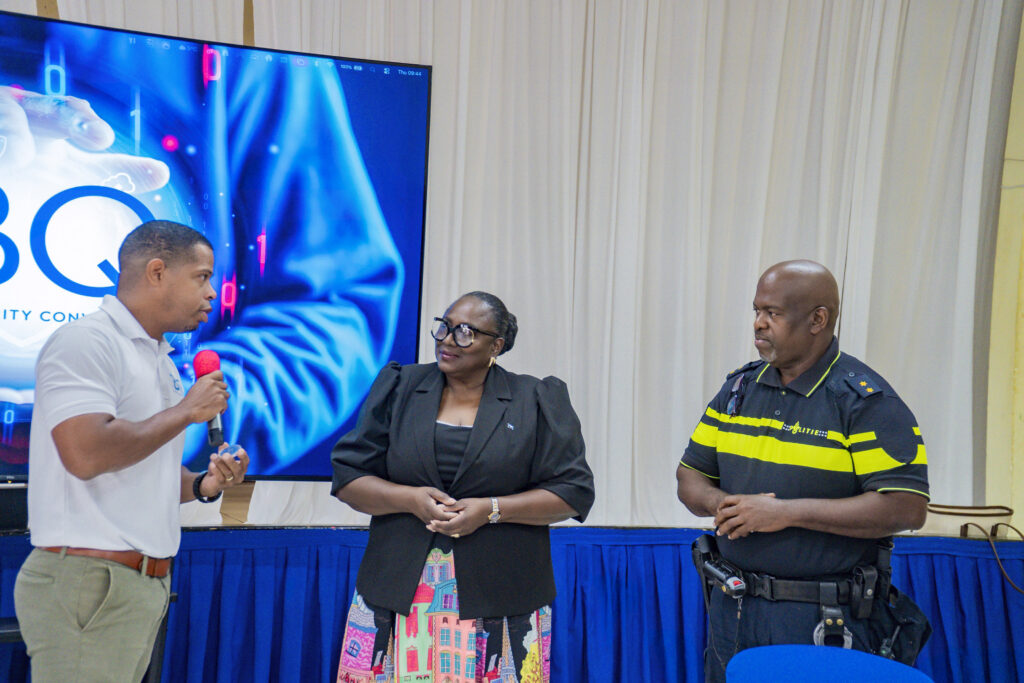
On Sint Eustatius (‘Statia’), a small island with just over 3,000 residents, disruptions are felt immediately across the community. As digital services expand, so does the need to strengthen cyber resilience. This urgency was central to the first BQ. Cybersecurity Convention, held on the island last April. The event brought together representatives from government, the Dutch Caribbean Police Force (KPCN), the financial sector and other organisations from across the Caribbean Netherlands to share knowledge and strengthen cooperation on digital security.
Opening the convention, Lady Alida Francis, Island Governor of Sint Eustatius, emphasised that digital resilience is not merely about technology. “For small island communities, resilience starts with trust, visible leadership and cooperation,” she said. With collaboration a recurring theme throughout the convention, Francis’ message is clear: “Digital resilience is a shared responsibility. Government, businesses, schools and residents all have their part to play in maintaining a safe and reliable digital environment. Awareness must lead to preparedness. Preparedness must lead to collaboration, and collaboration must lead to structures strong enough to endure disruption.”
Regional collaboration
Regional collaboration is already taking shape through partnerships with neighbouring Saba and Sint Maarten. The BQ Cybersecurity Convention was held on both Saba and Statia for the first time in April and will return to Bonaire for its fifth edition in October this year. The event aims to bring together key players in the cybersecurity sector across the Caribbean Netherlands, including chain partners, vital infrastructure operators, government agencies, and other stakeholders. Its goal is to share knowledge, discuss practical challenges, and strengthen cooperation on digital resilience. “Small island communities face similar challenges, such as limited capacity and growing reliance on digital systems,” Francis says. “But our scale also allows us to move quickly and stay close to the community.” She also refers to the E8 partnership between Bonaire, Statia and Saba (BES) and the Wadden Islands, which enables small island communities to exchange knowledge and support one another in addressing shared challenges including governance, safety and resilience: “8 islands, 1 voice,” she says.
Building resilience across the community
Francis stresses that digital resilience must remain inclusive, particularly for vulnerable groups such as older residents and young people, who may be more exposed to online risks. The introduction of the Citizen Service Number (BSN) last year is an important step towards improving access to digital services and economic participation. “Our objective is simple,” she says. “To ensure digital progress benefits the entire community and that no one is left behind.” This also includes practical awareness initiatives for residents, such as the public Cyber Awareness Night held during the convention, where attendees received tips on recognising online scams, protecting personal data and staying safe online.
The ‘cyber mayor’ approach
Francis emphasises that cybersecurity is no longer a niche issue. “It is part of good governance, reliable public service, economic confidence and the protection of critical infrastructure,” she says. “Leading by example means actively putting the topic on the agenda and encouraging responsible and safe behaviour.” On Statia, her leadership is highly visible. Francis knows most residents personally and believes digital resilience starts with staying close to the community and communicating clearly about risks and responsibilities. “We’re collaborating with the Dutch Caribbean Police Force (KPCN) and the Gwendoline van Putten School, Statia’s secondary and vocational school,” Francis explains. “We’re also linking this to programmes such as ProDemos – a civic education programme under my responsibility – where students learn about democracy and online risks.”
Lessons from physical crises
Statia’s experiences with hurricanes and COVID-19 strongly shape the island’s approach to digital resilience today. During the pandemic, Francis regularly addressed residents via radio updates to explain measures, answer concerns and counter misinformation. “People wanted to know what was happening, what it meant for their families and what they needed to do,” she says. “In a crisis, people need clear and understandable information.” According to Francis, many of the same principles apply during digital incidents: visible leadership, clear communication, timely decision-making and coordination between organisations. She notes that this is especially important for critical infrastructure such as the island’s port, which plays a key role in regional supply chains and is increasingly connected to digital systems. At the same time, Francis highlights that cyber threats also require specialised technical support.
Shared responsibility
Francis emphasises that digital resilience ultimately begins with everyday awareness and shared responsibility among government, residents and businesses. “Be cautious with suspicious messages, use strong passwords, and keep devices and software up to date,” she says. Recognising risks such as phishing, fraud and misinformation is an important first step in preventing incidents. “But awareness alone is not enough,” Francis stresses. “Cyber resilience must become part of how we work every day. Digitalisation brings opportunities, but also a responsibility to safeguard reliability, transparency and personal data.”
Caribbean Cyber Resilience Programme
This interview is the fourth in an ongoing series as part of the Caribbean Cyber Resilience Programme, linked to the Dutch Government-wide Cyber Exercise.
Would you like to explore this topic further? The programme consists of 5 webinars on Cyber Resilience, tailored to the small-scale context of the Caribbean islands.
The webinars are available on demand on the Caribbean Cyber Programme’s website.


